Showing posts with label kindergarten. Show all posts

Thursday, 8 January 2015

Use Flash Cards to Teach Preschool and Kindergarten Maths

What is a flashcard?
A flashcard is a piece of paper or card with a letter, a number, a word or a picture written on it. Sometimes there is something written on the other side (e.g. translation, answer, name, etc.)

Why are flashcards useful?
Flashcards are useful because we can use them many times. They provide variety and interest for children. We can use them for literacy practice, both English and other langauges (letters at P1 and words at P2-P3, etc.), for maths literacy (learning numbers and symbols +, x, =, etc.), for memorising vocabulary and for encouraging children to be creative. Each teacher can keep his / her own set, and can add to them all the time. You can keep your flash cards in a box, divided into different categories (letters, pictures, nouns, verbs, etc.)

How do I make flashcards?

Basic Flashcards
You just need paper and a marker pen. If you need a marker pen, ask your head teacher. Even if you don’t have a marker pen, you can make them with a bic (see picture below), or with coloured chalk; blue and purple work best.

Hanging Flashcards
These are very good when you want to combine flashcards in an order (e.g. maths sums, or sentences in English). You need larger pieces of paper / card, which are folded. You also need a piece of string that you can hang beneath or across the chalk board (see picture below). You can write on both sides of the card and flip them over.
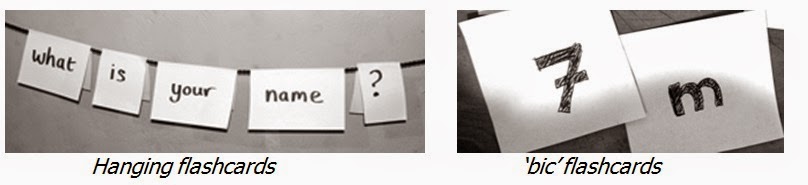


What activities can I do with flashcards?

Basic Literacy
1) Show & Elicit (P1-4) Show the flashcard and elicit the word / number / name / translation
2) Point at (P1-3) Flashcards are held up by students in different parts of the room. Tell the other students to point at one card.
3) Give me (P1-4) Put many flashcards on the floor. Tell one student to bring you one card.

Sequence Formation
1) Make a sentence (P2-6) Stand several students in a line at the front of the class, each with one flashcard. The others must tell them to stand in the correct order.
2) Creative maths (P1-3) Display number and symbol flashcards. Ask students: ‘Who can make a sum?’

Vocabulary learning
1) Translate (P1-6) Show English, elicit Kinyarwanda (on the back) or vice versa.
2) Vocabulary Box (P1-6) Keep the class flashcards in a box. Each day, one student can come to the front to test the others on the pronunciation / meaning / translation of the cards.

These are simple ideas. There are many more ways to use flashcards.


What will you use flashcards for?

More creative maths for kindergarten and preschool, visit www.eimaths.com 

Sunday, 28 December 2014

Preparing for Preschool - To-Do List

For many little children, preschool is their very first experience of practical life and this is the place where they begin to get a certain idea of what the next fifteen to twenty years of their lives will look like (they do not know that, of course!). Many children may not feel that great about having to leave the protection of their homes so soon and to spend so much time surrounded by strange,  unrecognizable faces. Thus, parents are suggested to make sure their child is taken care of before they start their formal pre-education. Here is a to-do list to help them out and to provide a little guidance.      \

Before enrolling the child into the school check out the school’s policies, their curriculum and the general environment at the place. Try to compare two or more schools to pick the best one possible.

 ·         Make sure the school has all the emergency information they may require to keep the child safe during unforeseen circumstances and to make sure he/she is delivered safely back to parents/guardians.

·         Make a plan on the steps to take if the child falls ill and has to go on an extended leave. Discuss with the teachers how the child can get updated once he/she gets back.

·         Teach the child that it is necessary to pick healthy foods at the cafeteria by making sure only healthy food items are packed into the lunchbox during preschool days.

·         Make sure that the preschooler actually looks forward to following a proper routine. Make sure there is something interesting lined up for every next activity due. For example, mothers can plan next morning’s breakfast with their child during bedtime.

·         Make sure that preschoolers do not overdose on the junk they show on TV nowadays. Steve Jobs, the founder and CEO of Apple Inc. (while he lived) said that he made sure all electronics stayed away from his kids when they were young so that they would play outside. He believed this allowed them to have a wider perspective on life.

·         Have a corner for school things at the house where kids can review their school stuff every night before bed and tell parents if they need something for the next days or coming days.

·         Talking to the child and ensuring that he or she is ready for their school going experience is as important as actually enrolling them in school. Ask the child if they have any fears they would like to address or any questions about school they want answered.

·         Make sure the child knows what their home address is along with the number used by either parent for contact in the case of emergencies.

·         Make sure the child knows the rules about strangers. Review the rules as often as possible; do not talk to strangers, do not listen to what they say and do not get into their cars, no matter how nice they appear to be.

·         When starting school it is necessary to ensure the child’s health and thus, a meeting with the teacher is recommended. If there are any ban foods for the kid, tell her about them. In contrast, ask her/him to send regular health reports in any form possible.

·        Of course, shopping for preschool is required too and it is slightly different from shopping for kindergarten. For starters, lesser pencils are required and more toys are needed. There are other things to consider too and one can find shopping lists for preschoolers online on many a website.

·         The clothes one buys for their child should have the ability to look just as good when they are mixed and matched as well. It is not really smart to buy a new outfit for every day in the month. 

For more preschool and kindergarten maths tip, check this out.